
This article is part of the RuralRISE Farming & Technology Series, a multi-part examination of how connectivity, data, and emerging technologies are reshaping agriculture and rural economies.
When most people hear “artificial intelligence in agriculture,” they picture a $500,000 autonomous tractor rolling across 10,000 acres of corn. That image is real, but it’s only a small part of the story.
What is actually happening on the ground looks different and more immediate. AI tools designed for farm use are available today, many at low or no cost, and they do not require large-scale equipment or significant capital investment. What they do require is a reliable internet connection.
The distinction between existing tools and those that are actually reachable is one of the central questions facing rural agriculture right now.
What AI Does (In Plain Language)
AI, at its core, is pattern recognition at scale. Fed sufficient data (weather patterns, soil moisture readings, crop images) these systems can identify trends, predict outcomes, and flag problems faster than any human analyst.
In agriculture, that capability is being applied to some of farming’s oldest and most economically consequential challenges: planting decisions, irrigation timing, and early disease detection. AI in farming surfaces the most relevant information at the right moment, enabling producers to make faster, better-informed decisions with greater confidence.
The value lies in sharpening farmer judgment. That capability is now available across a range of tools and price points, and it does not require a large operation to access.
Where AI Is Already Showing Up on Smaller Operations
The most accessible applications are already in use, available at low or no cost, and require nothing beyond a smartphone and a broadband connection:
Disease and pest identification.
Apps like Plantix or Google’s plant identification tools let a farmer take a photo of a leaf and receive an instant disease diagnosis, including severity and recommended treatment. This used to require an agronomist visit or an extension agent appointment that could take days. Now it takes 30 seconds, a smartphone, and a reliable connection.
Hyperlocal weather and decision support.
Platforms now deliver field-specific forecasts and planting window recommendations. A small vegetable grower can know that their particular hillside will see frost two nights from now, allowing them to plan and act accordingly.
Soil and input optimization.
AI-assisted soil and input tools analyze field-level data to recommend precise application rates, reducing the overuse of fertilizers, pesticides, and water that drives up operating costs on farms of every size.
The barrier to entry for these tools is not equipment or capital. It is connectivity — and that distinction matters for how policymakers, funders, and rural development organizations think about access to technology in agriculture.
Where AI Delivers Measurable Results in Controlled-Environment Production
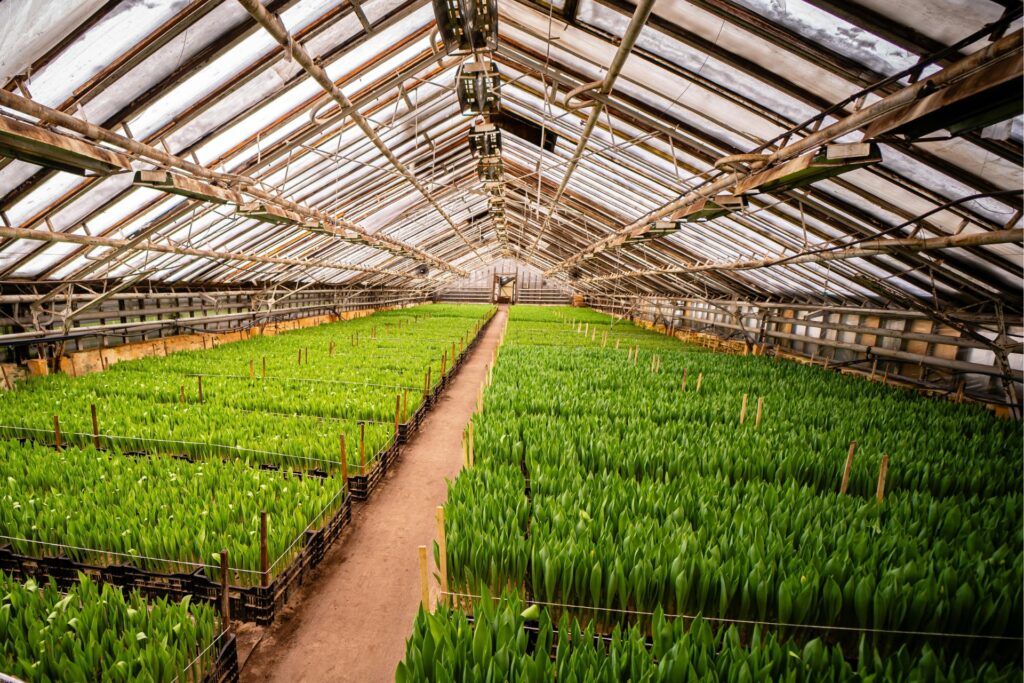
Greenhouse and controlled-environment agriculture may represent the clearest near-term picture of what AI can actually deliver on a working farm.
The reason is structural: unlike open-field production, where variables such as weather, soil composition, and pest pressure vary constantly across acres, controlled environments generate continuous, measurable data streams. Temperature, humidity, light levels, nutrient concentration, and water use can all be monitored in real time. That data density is precisely what AI systems are designed to work with.
The result is a setting where AI moves from theoretical capability to practical farm management tool. Climate control and energy efficiency are among the most documented applications — AI-assisted systems can monitor environmental conditions continuously and adjust heating, cooling, and ventilation in response, reducing energy consumption while maintaining optimal growing conditions.
The same principle extends to pest detection, irrigation management, and harvest planning; each an area where continuous data collection enables earlier intervention and more efficient resource use.
For smaller operations, controlled-environment production is particularly relevant. Greenhouse farming requires significantly less land than open-field agriculture, can extend growing seasons in difficult or short-season climates, and is increasingly viable at scales that do not require large capital investments in equipment.
What AI Means for the Next Generation of Rural Agriculture
One of the structural questions facing rural agriculture over the next two decades is the workforce pipeline. According to the USDA 2022 Census of Agriculture, the average U.S. farmer is 58 years old. That demographic reality has direct implications for farm succession, rural economic continuity, and the long-term viability of smaller operations.
The National FFA Organization now counts more than one million members across 9,407 chapters in all 50 states (a record high) and 81 percent of its student members report interest in learning about technology. USDA’s National Institute of Food and Agriculture reports that 4-H reaches six million young people annually. Together they represent the largest youth agricultural education network in the country. At the same time, USDA NIFA has found that more than half of the rural workforce currently lacks the information technology skills needed for 21st-century jobs.
That connection between agricultural interest and technology skills is not new. More than a decade ago, we worked with students in West Virginia on a statewide competition designed to engage rural youth in agricultural technology. That effort demonstrated what researchers and educators have since documented more broadly: when young people in rural communities are given access to real tools and concrete problems drawn from their own agricultural context, engagement follows. The challenge was never interest, it was access.
Two national programs now operating at scale offer more recent evidence of that dynamic. In May 2025, Microsoft and the National FFA Organization announced the national expansion of FarmBeats for Students, integrating smart sensors, data science, and artificial intelligence to teach precision agriculture in classroom settings at no cost to FFA chapters in 185 middle and high schools across all 50 states. The National 4-H AI in Agriculture Challenge produced similar results — participating students designed tools addressing real farm management problems, from disease detection to soil analysis, built on agricultural knowledge they already had.
Taken together, these programs suggest that when rural youth have access to the right tools and a concrete problem to solve, the intersection of agricultural knowledge and emerging technology becomes a viable career framework, not a departure from rural life, but an evolution of it.
Digital Literacy and the Risks That Come With AI Tools
Expanding access to AI tools in rural agriculture is not sufficient on its own. Digital literacy in this context means more than knowing how to operate a platform. Rural producers need to understand data privacy, evaluate whether a platform is legitimate before entering operational data, and recognize the growing category of AI-generated misinformation and technology-adjacent scams that increasingly target them.
Fake input suppliers, fraudulent crop insurance schemes, and phishing attempts designed to mimic legitimate ag-tech platforms are documented and growing threats. Extension services, ag-tech developers, rural nonprofits, and policymakers all have a role in helping producers navigate those risks.
The Connectivity Question AI Makes Unavoidable
Every tool described in this article depends on the same foundational requirement: a reliable, affordable, high-speed internet connection. Disease detection apps, hyperlocal weather platforms, AI-assisted greenhouse monitoring, and decision-support systems won’t function without it.
That dependency sharpens a question the rural broadband conversation has not yet fully answered. Deployment maps and funding totals measure whether infrastructure exists. They do not measure whether that infrastructure is performing well enough to support the tools that rural agriculture increasingly depends on. A farm with a technically “served” broadband connection may still lack the speed, latency, or reliability that AI-assisted farm management actually requires.
That gap between infrastructure presence and functional performance is where the most important unanswered questions now live. Can a farmer in central Maine reliably access a satellite crop monitoring platform? Can a greenhouse grower in rural New Mexico run an AI irrigation system without interruption? The answers vary significantly by location, provider, and the specific demands of the tools used, and they are not consistently tracked.
RuralRISE is focused on exactly that question: whether connectivity in rural America is translating into real outcomes for the farms and communities that depend on it. That means moving beyond coverage maps to understand what rural producers can actually do with the connections they have, and where the gaps between available tools and accessible tools remain widest.
What Comes Next (and What Still Needs to Be Answered)
The case for AI in rural agriculture is no longer speculative. The tools exist, the applications are documented, and the economic arguments are increasingly well-supported. What remains unresolved is whether the conditions required to use those tools are actually present across the rural communities that stand to benefit most.
That question has two parts. The first is infrastructure: whether broadband connectivity in rural America has reached the speed, reliability, and latency thresholds that AI-assisted farm management genuinely requires — in practice, on working farms. The second is capacity: whether rural producers have access to the technical support, training, and digital literacy resources that translate an available tool into an adopted one.
Both questions are answerable, but they require better data than currently exists. Deployment metrics tell one part of the story. What they do not capture is whether connectivity translates into outcomes, and whether the farmer in a technically served area can actually run the tools now being built for operations like theirs.
Those are the questions RuralRISE is committed to tracking. Not the version of rural ag-tech that reads like a product launch, but the ground-level reality of which tools are reaching which farms, under what conditions, and with what results. The broader questions around AI infrastructure (including data centers, energy demands, and community impact) are part of a separate but related conversation that RuralRISE is following closely.
That work begins with understanding what rural producers can actually do with the connections and resources they have today.
This article is part of the RuralRISE Farming & Technology Series, Dirt to Data:
Part 1: From Dirt to Data: How Connectivity Is Reshaping Farming in Rural America
Part 2: Precision Agriculture: The $18 Billion Opportunity Sitting in a Connectivity Gap
Part 3: AI in Rural Agriculture: What’s Available, What’s Missing, and What It Means (this post)
Part 4: Drones and Remote Sensing: A Rural Agriculture Tool With a Connectivity Catch
Part 5: Farm Equipment & Automation — coming soon
Part 6: Workforce & the New Ag Economy — coming soon
Part 7: The Digital Divide in Agriculture — coming soon
Sources
- USDA National Agricultural Statistics Service, 2022 Census of Agriculture: Farm Producers Highlights
- Practical Advice on Implementing AI in Your Greenhouse Business, Greenhouse Grower, January 2025
- Making Smart Greenhouse Farming Accessible to All, Hortidaily, September 2025
- How AI is transforming Greenhouse Operations
- USDA Technology Use (Farm Computer Usage and Ownership), August 2025
The data and statistics referenced in this article reflect information available at the time of publication. Figures may be updated as new research becomes available; readers are encouraged to consult the original sources directly for the most current information. References to organizations, companies, programs, or products are for informational purposes only and do not constitute an endorsement by RuralRISE.