
This article is part of the RuralRISE Farming & Technology Series, a multi-part examination of how connectivity, data, and emerging technologies are reshaping agriculture and rural economies.
When most people imagine automation in agriculture, they picture something large, expensive, and out of reach for the average rural operation, but that picture is incomplete. Farm automation doesn’t fit into one technology category or one price point, and many rural operations already fall somewhere in that range without thinking of themselves as automated at all.
Understanding where that range starts, what it actually costs, and what it can realistically do for operations of different sizes is increasingly relevant as farms look for ways to do more with the labor and resources they have.
What “Farm Automation” Actually Means
Before we get into what’s working and what isn’t, it’s worth pausing on a word that gets used far more than it gets explained: automation.
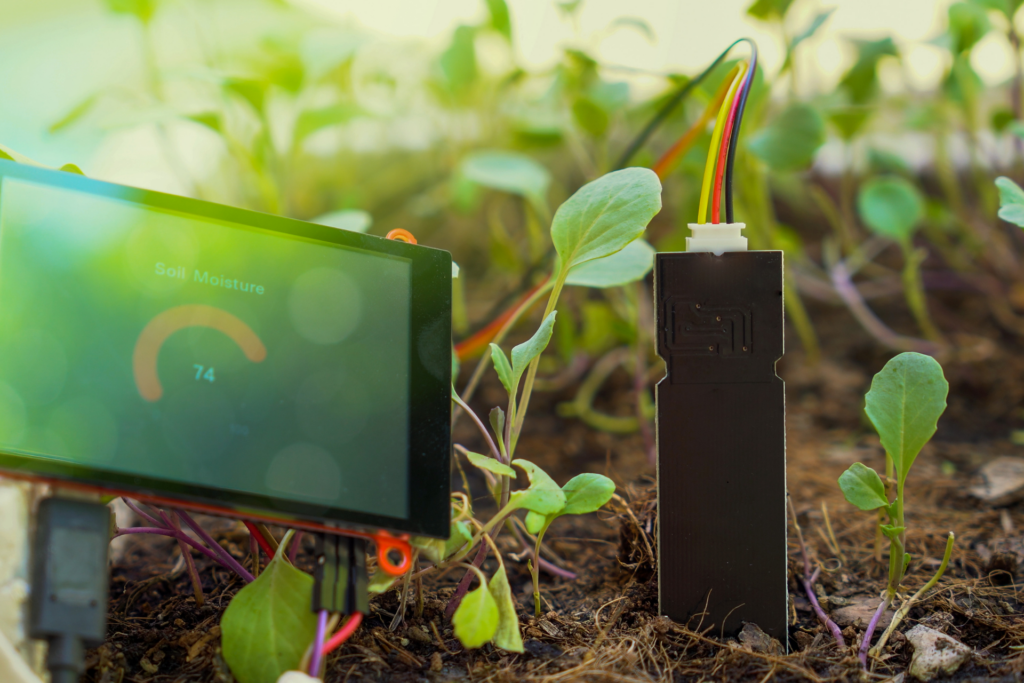
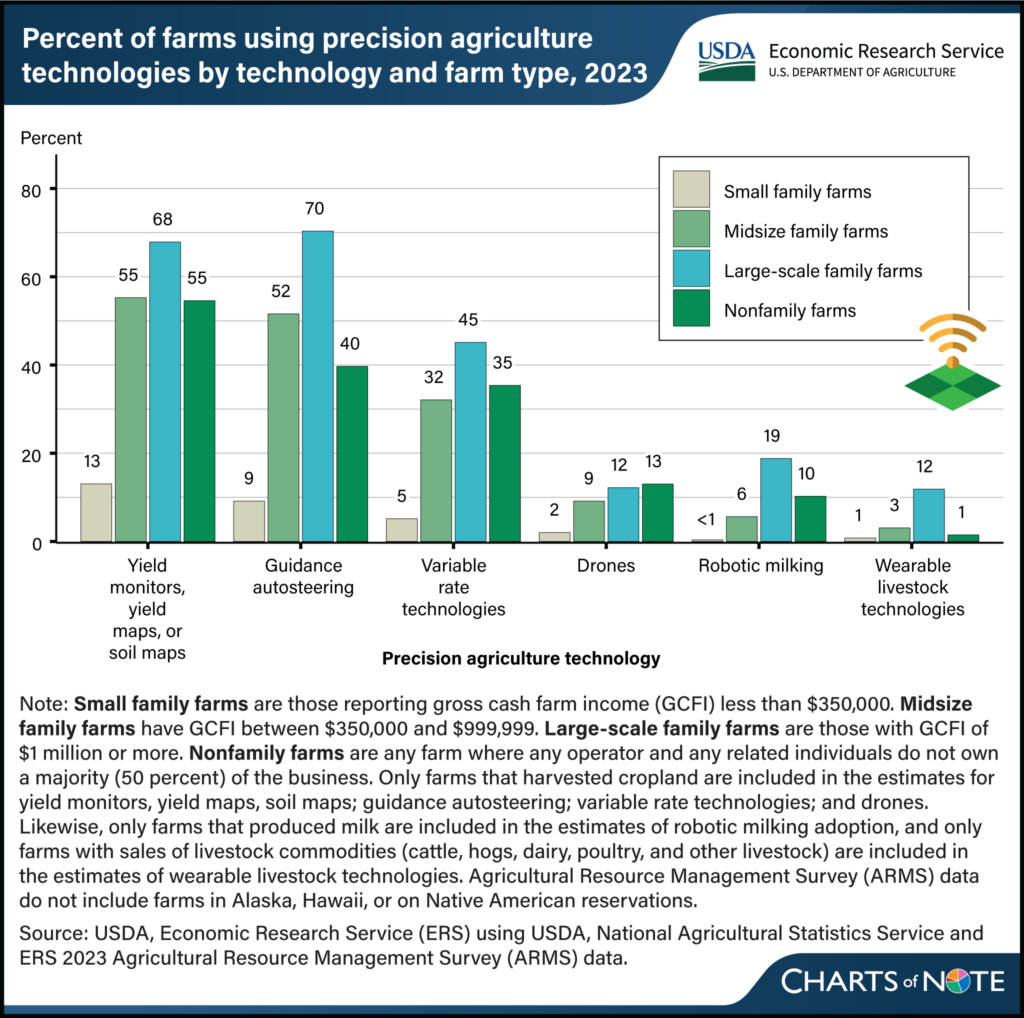
At the simple end, automation might mean automated water sensors or feeders on a small operation. For row-crop farms, it’s often GPS-guided autosteer, which keeps a tractor on a straight, precise line so the operator isn’t fighting the wheel for ten hours a day. This is now fairly common in most mid- to large-sized tractors.
A step up from that is variable-rate technology, where a planter automatically adjusts seed application row by row based on soil and yield data, instead of applying one blanket rate across an entire field. Further along is full autonomy: a tractor or robotic system that operates with no one in the seat, making its own steering, speed, and obstacle decisions in real time.
The opportunity underneath it all is the same: machines taking over the repetitive, physically demanding, or precisely calibrated parts of farm work, freeing producer time and capital for other demands. Done well, that can mean fewer hours in the seat, more precise input use, less waste, and a way to keep an operation running when labor is not available.
The Automation That Doesn’t Make Headlines
The engineering behind a tractor driving itself down a field — correcting its own line, turning without a hand on the wheel — is genuinely impressive engineering, and it’s understandably the piece of farm automation most people carry when they hear the word automation.
But much of the automation that actually changes daily operations on a farm is quieter and more practical than that, using tools addressing specific, repetitive tasks rather than replacing the operator entirely
Livestock operations are seeing their own version of automation, and it looks nothing like a driverless combine. Some of the most useful examples don’t make headlines: automatic feeders, climate-controlled barns and coops, and float-valve stock waterers have been quietly doing their jobs for years, and they tend to be far more accessible and affordable for the average rural farmer than anything with “autonomous” in the name.
But not every example is equally accessible yet.
Virtual fencing is commercially available, but much of its current use is still moving through university and grant-funded pilot programs rather than broad adoption by ranchers. The appeal for virtual fencing is easy to see. For generations, rotational grazing has meant physically tearing down and rebuilding fence lines every time cattle need to move to fresh pasture. GPS-enabled collars now let a rancher draw a new boundary from a phone and move the herd without touching a wire.
Missouri farmer Christopher Hudson, testing the technology through the University of Missouri’s Center for Regenerative Agriculture, used to spend thirty minutes a day moving hot-wire fencing by hand. Now he can plan a week of pasture moves in a single evening from his living room.
In eastern Washington, one ranching family used a similar system on a 12,000-acre open-range grazing permit, cutting what had been a six-day-a-week job of range riders patrolling on horseback down to three to five days a week, a reduction that translated directly into recovered time for the operation’s family.
Virtual fencing represents a meaningful upfront investment, particularly for small operations. But the labor savings can justify the cost for medium- to large-scale operations.
Robotic and laser weeding is doing something similar for row-crop and specialty operations. Some systems use computer vision to identify weeds and eliminate them with a precision laser, no herbicide required. Others use mechanical tilling arms that target individual weeds without disturbing the surrounding crop
Neither makes for as dramatic a demo as a driverless tractor, but automation scales fastest wherever a task is repetitive, physically hard, and consumes labor that could be directed elsewhere.
What the Research Shows About Automation and Farm Life
The Iowa Farm and Rural Life Poll (established at Iowa State University in 1982 and still run annually) is the longest-running survey of its kind in the country. It has tracked farm family quality of life, stress, and satisfaction for more than four decades, and has periodically examined farmers’ use of and attitudes toward new technology, including a 2025 survey on agricultural drones.
Longitudinal surveys like this are among the most valuable tools for understanding how rural communities experience technology over time — whether that tech is working, who’s using it, and what it’s changing on the ground. That kind of sustained, pattern-level tracking is what RuralRISE considers essential to understanding rural agriculture accurately, and what this series is designed to reflect.
The Structural Shift Driving Adoption
The labor pressure driving automation adoption is real and documented. The number of producers aged 35 to 64 fell nine percent between 2017 and 2022, even as the number of producers 65 and older grew twelve percent, according to USDA’s 2022 Census of Agriculture. The average U.S. farmer is now 58.1 years old. That’s a structural shift in who is left to do the work, not a passing one. Automation didn’t create that gap. It’s one of the tools responding to it.
The difference between an impressive demonstration and a machine a farmer can actually depend on comes down to installation, operator training, connectivity, and what happens when the system hits something it wasn’t built to expect. And none of it works without three things: reliable rural connectivity, farmers equipped to use and maintain what they’ve bought, and trained technicians who can step in when something goes beyond a basic fix.
Different Scale, Same Logic
The labor argument plays out differently depending on the size of the operation, but the underlying logic holds everywhere: automation earns its place by giving time and effort back to people who are stretched thin, not simply because the technology is available.
On a large operation, that might mean a fleet of autonomous equipment or industrial-scale weeding robotics replacing a workforce that’s grown increasingly difficult to hire
On a small or mid-size operation, the tools tend to be more targeted — a single retrofit kit, wireless sensors in a greenhouse, a maple tubing leak detection system, or a shared piece of equipment through a co-op. The goal is rarely expansion. Rather, it covers a specific operational gap with the labor and resources available.
Building the Workforce Behind the Machines
None of this equipment runs, calibrates, or gets repaired by itself, and that reality has created a concrete opportunity for rural communities to build something durable: a local workforce trained to install, maintain, and troubleshoot it.
Flint Hills Technical College, in Emporia, Kansas, is a good example of what that looks like in practice. In late 2024, the college received a $672,288 grant from the Patterson Family Foundation, a Kansas City nonprofit whose mission is explicitly to help rural communities thrive, to launch a Precision Agriculture Technology program that began enrolling students in August 2025. The three-year grant is funding new faculty, lab equipment, a greenhouse for hands-on crop science instruction, and, notably, a Commercial Driver’s License training track integrated directly into the program, so graduates leave with more than one path into a paying job.
This is precisely the kind of institution this series keeps returning to: a technical college in a farm town building a program around a real and growing regional need. Programs like this one exist at community and technical colleges across the country, but Flint Hills’ pairing of a rural-focused foundation with a hands-on, one-year certificate track is a clear example of the ecosystem this series has argued is necessary: infrastructure, training, and local capacity, built together rather than assuming one produces the others.
Longer certificate programs aren’t the only path in, either. University extension offices — the outreach arm of land-grant universities, working alongside community colleges in many of these same towns — regularly run shorter, practical sessions built for farmers who can’t step away for a semester.
The University of Missouri Extension, for instance, hosted a one-day workshop in Auxvasse, Missouri, in late 2025 called “Opportunities for Drones in Agriculture,” covering FAA regulations, remote pilot certification, and hands-on flight practice for producers and agribusiness professionals. It’s a smaller commitment than an associate’s degree, but the same underlying idea: local, practical, one-time entry points that meet farmers where their schedules actually are.
Beyond the Demo Reel
The self-driving tractor is an impressive piece of engineering, but it’s one tool among many, and not even the one having the most impact on daily operations for most rural farms. The more consequential story is often quieter — a rancher recovering a day’s worth of labor through virtual fencing, or a small operation covering a task that would otherwise go undone. And a technical college in Emporia, Kansas, and extension programs across the region are building the workforce that will install, maintain, and troubleshoot these systems for the operations that adopt them.
This is an overview, not the final word. Each technology referenced, from virtual fencing to weeding robotics, autonomous tractors to variable-rate planting, has real upsides and real tradeoffs that deserve a closer look: cost, reliability, and what happens when the connectivity or training behind them isn’t there. This series will keep examining those specifics as it continues.
For now, the throughline holds: automation on the farm is broader and more accessible than the headlines suggest, but understanding it means looking past the demo reel to what it actually takes to make these tools work.
This article is part of the RuralRISE Farming & Technology Series, Dirt to Data:
Part 1: From Dirt to Data: How Connectivity Is Reshaping Farming in Rural America
Part 2: Precision Agriculture: The $18 Billion Opportunity Sitting in a Connectivity Gap
Part 3: AI in Rural Agriculture: What’s Available, What’s Missing, and What It Means
Part 4: Drones and Remote Sensing: A Rural Agriculture Tool With a Connectivity Catch
Part 5: Farm Equipment & Automation (this post)
Part 6: Workforce & the New Ag Economy — coming soon
Part 7: The Digital Divide in Agriculture — coming soon
RuralRISE is committed to broadband access, digital equity, and rural economic development across America. To learn more about our work or explore our Ag & Technology blog series, visit ruralrise.org.
Sources
Ward, Mindy. “How Virtual Fencing Offers Farmers Hope for the Future.” Farm Progress, 2025. https://www.farmprogress.com/livestock/how-virtual-fencing-offers-young-farmers-hope-for-future
Merck Animal Health. “Make the Most of Your Crew’s Time with Virtual Fencing.” 2025. https://www.merck-animal-health-usa.com/hub/vence/resources/make-the-most-of-your-crews-time-with-virtual-fencing/
Iowa State University Extension and Outreach. “Iowa Farm and Rural Life Poll.” Ongoing since 1982. https://www.extension.iastate.edu/ag/iowa-farm-and-rural-life-poll
USDA National Agricultural Statistics Service. “Farm Producers.” 2022 Census of Agriculture Highlights, 2024. https://www.nass.usda.gov/Publications/Highlights/2024/Census22_HL_FarmProducers_FINAL.pdf
Emporia Gazette. “FHTC Recipient of Patterson Family Foundation Grant to Support Precision Agriculture.” November 14, 2024. https://www.emporiagazette.com/education/article_3c7aacde-a2ac-11ef-80fd-e7e5eacd3384.html
“MU Extension Workshop Helps Farmers’ Drone Skills Take Flight.” The Unterrified Democrat, October 29, 2025. https://www.unterrifieddemocrat.com/stories/mu-extension-workshop-helps-farmers-drone-skills-take-flight,242717
New Mexico State University. “Virtual Fencing Using e-Collars vs. Physical Fencing Cost Comparison on New Mexico Cattle Ranches: Part 2 of 2” https://pubs.nmsu.edu/_b/B133/index.html
Farm Progress, “Virtual Fencing Technology Gains Ground in U.S.,” 2025, https://www.farmprogress.com/technology/virtual-fencing-technology-gains-ground-in-u-s-
University of Missouri, “Mizzou Expands Virtual Fencing for Cattle in Missouri and Nebraska,” April 2026, https://showme.missouri.edu/2026/mizzou-expands-virtual-fencing-for-cattle-in-missouri-and-nebraska/
The data and statistics referenced in this article reflect information available at the time of publication. Figures may be updated as new research becomes available; readers are encouraged to consult the original sources directly for the most current information. References to organizations, companies, programs, or products are for informational purposes only and do not constitute an endorsement by RuralRISE.